
Aseem Chhabra's recommendations for the Mumbai film festival.

'The Modi regime, after experimenting with its own versions of neighbourhood policy for 18 months, has now reached the exact stage where the Manmohan Singh government had left it in so far as our Pakistan policy is concerned,' says former senior RA&W officer Vappala Balachandran.

'He represented the warmth, gentleness and goodness that existed in Hindi cinema before Bollywood became a loud commodity.' Aseem Chhabra on the legendary actor he admired for over 40 years.

Ivan Lendl might be 'way too busy' to be his mentor but Tomas Berdych has not given up the dream of jumping on the 'super coach' bandwagon.

Global investor and author Jim Rogers, who recently sold his India investments, talks about his disappointment with Prime Minister Narendra Modi's economic reforms, why he is betting big on the US dollar and the Chinese Renminbi and what will bring him back to India some day.

India has made a remarkable journey from a top-down system of economic decision-making to one that unleashed our entrepreneurial spirits but the next big jump lies in enhancing the quality of our tale.

How will the return of a majority government at the Centre, the new India-US friendship and the Mangalyaan triumph change India?

If the aim is to become a player with some strategic space of its own, not just in the Indian Ocean region but also in the adjoining region, then greater interaction with China is desirable, even necessary.
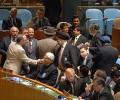
'Under Narendra Modi's leadership, we will be able to regain our rightful place in the community of nations,' veteran diplomat Hardeep Singh Puri, who joined the BJP on January 2, tells Rediff.com's Sheela Bhatt.

'Chinese leaders rarely receive their foreign guests in cities other than Beijing. Such respect for India!' 'Does it mean that Modi could replicate "the warmth and unconventional way" by sending Indian troops into Tibet, as Xi did in Chumur (Ladakh) when he arrived in India? Of course, Indians are far too polite to do so,' says Claude Arpi.

From France to Canada, from Japan to South Korea, all of Modi's barbs came in front of an NRI audience. Over the last one year, with 19 foreign visits, Modi has tried to use diplomacy as a PR event and foreign policy as a means to shore up his image back at home, says Shehzad Poonawalla.

Here are some of the most stunning moments of the week that was.

'There is much symbolism in President Pranab Mukherjee's participation in the Victory Day celebrations in Moscow.'

Prime Minister Narendra Modi enjoys a close relationship with Shinzo Abe. For Abe, "a strong India is in the best interest of Japan, and a strong Japan is in the best interest of India."

Raamdeo Agrawal says, an investor should figure out if the company actually makes money or not, making an investment comes later.
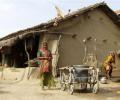
Armed with green nod and fund infusion, Gujarat govt getting ready to issue tenders to build infrastructure at the mega investment region

The India-Afghanistan relationship does not have to be a template of each country's relations with Pakistan, and Delhi will do well to leave it to Ghani to redefine the parameters of Afghanistan's security cooperation with India. A zero-sum mindset can only exacerbate regional tensions, says Ambassador M K Bhadrakumar.

'The Modi government's lurch toward America has not brought it any dividends so far. The Western world is simply not in a position to make big investments in India... India needs to take a leap of faith vis-a-vis China.'
Based on the GDP numbers and the remarkable stability of the taka Bangladesh's Prime Minister, Sheikh Hasina, is a better manager than our 'economist prime minister',' says TVR Shenoy.
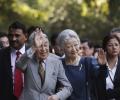
In the media frenzy over inconsequential issues, the visit of the Emperor of Japan to India has been pushed to the margins of public discourse. Colonel (retd) Anil Athale explains the great historical and political significance of the visit.

2014 was a year for downturn for most economies across the globe.

Despite vast differences in the way the media operates in the two countries, an India-China media forum will go a long way in improving understanding between the two countries, says Srikanth Kondapalli.

Prime Minister Narendra Modi, who recently completed one year in office, has, in an exclusive interview with Smita Prakash, editor, ANI, said the opposition alleging that his government is a "suit boot ki sarkar" is definitely better and more acceptable than being labelled a "suitcase" (ki sarkar), and satirically added, that after ruling for sixty years, the Congress has suddenly remembered the poor.

'When he first came to office, my belief is that the PM's reading of the landscape was that, with a vanquished Congress and fragmented Opposition, he was looking at least at two terms in office. This reading perhaps allows for a more cautious, gradual approach.' 'It was only a matter of time before the government was forced to come face-to-face with a serious corruption scandal. This is not a commentary on the BJP, but a statement about India's political economy.' 'There is growing concern about the government's commitment to freedom of expression, religious tolerance, and an independent civil society. Thus far, the positive movement on strategic and economic matters has crowded out these concerns, but they are lingering beneath the surface.'

'It was China's rise that caused the New Cold War in Asia as it prompted the United States to rebalance its forces in Asia to experiment with engagement and containment at the same time,' says T P Sreenivasan.

Here are some of the best photographs clicked across the globe in the month of October.

The India that needs strategic alliances, defence cooperation and engaging meaningfully with neighbouring countries is quietly moving ahead with confidence, says Tarun Vijay

Once again an Indian prime minister has realised that with Pakistan and China, things will not move as he wishes.

The dollar is king in an intermediate correction, says Sonali Ranade

'A participant in many rounds of the border talks with China once told me that China seemed not interested in resolving the border issue as it wanted to keep it as a ready excuse to intervene in the sub-continent,' says Colonel (retd) Anil A Athale.

With Beijing having had a profound rethink on India's admission as a full member of the Shanghai Cooperation Organisation, the tectonic plates of the geopolitics of a massive swathe of the planet stretching from the Asia-Pacific to West Asia are dramatically shifting. That grating noise in the Central Asian steppes will be heard far and wide -- as far as North America, says Ambassador M K Bhadrakumar.

Slow pace of reforms in India is disappointing: Faber

The announcement of the formation of the BRICS bank will have as much an impact about how the non-G7 countries manage their economies and their foreign reserves, as it does on the intellectual discourse. The development priorities and agenda which was hitherto set by western experts responding mostly to western priorities and notions will now have to compete with an intellectual tradition that is and can be very different, says Mohan Guruswamy.
 © 2026 Rediff.com - Advertise with us - Disclaimer - Privacy Policy - Sitemap - Feedback - About us - Terms of use - Grievances